Queue
More...
|
| | Queue () |
| |
| | Queue (T[] list) |
| |
| void | Dispose () |
| |
| void | Clear () |
| |
| bool | Push (T item) |
| | Put element at the end of queue More...
|
| |
| bool | Push (T[] array) |
| | Put array of elements at the end of queue More...
|
| |
| T | Pull () |
| | Take first element from queue, remove it from queue, and finally return. More...
|
| |
| T [] | Pull (int count) |
| | Take number of elements from queue, remove them and return array of elements taken. Pull(0) will return all elements from queue and empty it. More...
|
| |
| T | Pull (double timeout) |
| | Take element from queue with specified time limit to wait for new item to come. It will pause invoking thread as it is expected to do so. More...
|
| |
| void | Back (T item) |
| | Put element back to queue, at begining. This element will be taken first. More...
|
| |
| void | Back (T[] list) |
| | Put array of elements back to queue, at begining. These elements will be taken first. More...
|
| |
| T | Chop () |
| | Delete last element from queue and return it. More...
|
| |
| T [] | Chop (int count) |
| | Delete number of last elements from queue and return them. More...
|
| |
◆ Queue() [1/2]
◆ Queue() [2/2]
◆ Back() [1/2]
◆ Back() [2/2]
◆ Chop() [1/2]
◆ Chop() [2/2]
◆ Clear()
◆ Dispose()
◆ Pull() [1/3]
◆ Pull() [2/3]
Take number of elements from queue, remove them and return array of elements taken. Pull(0) will return all elements from queue and empty it.
- Parameters
-
- Returns
- Array of elements
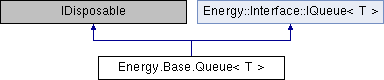
Implements Energy.Interface.IQueue< T >.
◆ Pull() [3/3]
Take element from queue with specified time limit to wait for new item to come. It will pause invoking thread as it is expected to do so.
- Parameters
-
| timeout | Time limit in seconds |
- Returns
- Element or default (null) if no elements in queue
◆ Push() [1/2]
◆ Push() [2/2]
Put array of elements at the end of queue
Using one element instead of array may be more efficient.
- Parameters
-
- Returns
Implements Energy.Interface.IQueue< T >.
◆ Circular
◆ Count
Return number of elements in queue
◆ IsEmpty
◆ Limit
◆ Name
The documentation for this class was generated from the following file:

 1.8.14